


The “severe” level of the healthcare crisis alert, issued on Feb. 23, 2024, will be lifted at midnight Monday, after approximately one year and eight months. Temporary fees maintained under the emergency medical care system will also end, with only some being retained.
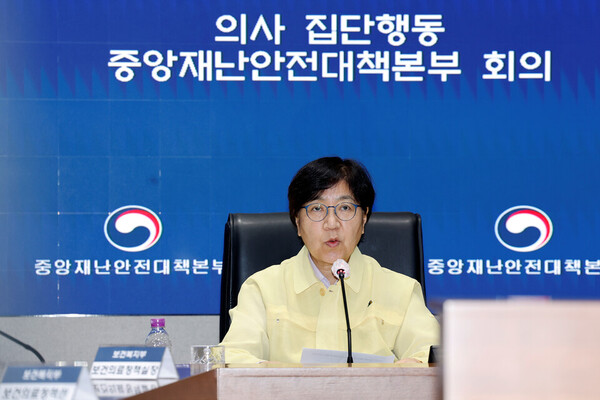
The Ministry of Health and Welfare made the decision during a meeting of the Central Disaster and Safety Countermeasures Headquarters for Doctors’ Collective Action on Friday.

The government declared the “severe” level health crisis alert last February after the medical community reacted strongly—including mass resignations by trainee doctors—following the Yoon Suk Yeol administration’s announcement to increase the medical school enrollment quota by 2,000 students.
The ministry determined that communication between the government and the medical community resumed after the Lee Jae-myung administration took office in June this year, and that mutual cooperation and efforts to normalize the medical system are underway. Accordingly, it held an internal crisis assessment meeting on Thursday to review the criteria for determining the health and medical crisis alert level, including the recovery rate in medical service volumes, the stability of the medical system’s operation, and the rate of resident doctors’ return to work.
The review confirmed that “treatment volume” had recovered to 95 percent of the level prior to the emergency treatment period, based on data from tertiary and general hospitals, compared to February 2024. “Stability of healthcare system operations” was assessed as having nearly recovered to normal capacity, with emergency rooms operating at 99.8 percent of their standard bed capacity and the number of emergency medicine specialists increasing by 209 compared to normal times.
Additionally, 7,984 interns and residents returned to training programs through recruitment in the second half of this year, restoring the resident workforce to 76.2 percent of the previous year’s level.
Based on these results, the ministry held a Central Disaster and Safety Countermeasures Headquarters meeting to lift the “severe” level of the healthcare crisis alert, effective at midnight on Monday, and to terminate the operation of the Central Disaster Management Headquarters.
“With the lifting of the crisis alert, measures implemented under the emergency medical care designation will end, and necessary future measures will be institutionalized,” Minister of Health and Welfare Jeong Eun-kyeong said. “Fees related to emergency medical care will be adjusted following a decision by the Health Insurance Policy Deliberation Committee at the end of October.”
Minister Jeong continued, “Temporary fees will be terminated, but some items that proved effective in maintaining emergency medical care will be converted to standard fees. Additionally, certain measures requiring a grace period, such as regional hub centers, will be maintained until year-end before termination.”
She also remarked that measures evaluated as beneficial for efficient resource management, including nurse-assisted medical care, non-face-to-face consultations, and hospitalist specialists, will be institutionalized.
“The government will use past experiences as lessons, designing the future of Korean healthcare based on mutual trust and cooperation,” Jeong said. “While the medical field is recovering thanks to the return of resident doctors and the hard work on the front lines, the journey toward normalizing Korean healthcare is just beginning.”
She continued, “To pursue healthcare reforms that resonate with both the public and the medical community, we will promptly establish the Public Participation Medical Innovation Committee, a social discussion body centered on participation, communication, and trust, to overcome the current regional and essential healthcare crises and enhance the public nature and sustainability of the medical system.”
Under the new medical reform framework, the government will focus on resolving “current gaps in healthcare where citizens are experiencing difficulties,” such as in pediatrics, obstetrics, and underserved areas.
The government will also seek practical solutions for various pending issues, including minimizing emergency room refusals and improving medical travel to the capital region. It also emphasized plans to pursue improvements in rehabilitation, long-term care, and end-of-life care. Additionally, it highlighted measures to strengthen regional, essential, and public healthcare through technological innovation, as well as solutions to structural problems in the healthcare system.
“The government will swiftly prepare a healthcare innovation roadmap that resonates with and gains support from both the public and the medical community to build a sustainable healthcare system,” Minister Jeong said.
link